Skip to content


Can capsule houses actually pass coastal wind codes? Can their steel frames handle coastal storms or strong seaside winds? Can these houses really survive near the coast? These are some of the questions that make every capsule homeowner think twice… before setting one up near the sea.
A capsule house looks light and small, but it’s not weak. Most of them use steel or aluminum shells that make them stronger than they appear. But strength alone is not enough.
Every coastal home must pass wind codes that prove it can handle pressure, uplift and fast moving wind. Actually these codes decide if your capsule house can safely stand on coastal land.If your capsule house follows the right design, anchors and foundation rules, it can pass those codes and last for years.
You just need to know what the rules mean, how to calculate your site numbers, and what design details make the biggest difference. Let’s talk about all that step by step.

What “passing coastal wind codes” means
To “pass” coastal wind codes, you must design your capsule house by the local building standard (mostly based on ASCE 7). First, you have to find the design wind speed for your location (from code maps). Then, you need to determine the risk category (most homes are Category II) and exposure category for your site.
Moreover, exposure categories describe “how open the terrain is”. For example: Exposure C means “open terrain with scattered obstructions” while Exposure D is “flat and unobstructed areas like water surfaces”. However, coastal sites are mostly Exposure D or C.
With those numbers, you need to calculate the design wind pressures on the roof, walls and openings. “Passing” means your house is built to resist those pressures. Then, you must have to show how your materials and structure meet or exceed the design loads. This involves providing product data and test reports for all parts (roof panels, wall panels, windows, doors) to prove they can handle the code pressures.
Another important thing is: a continual roof-to-foundation load path. This basically means every connection (roof-to-wall, wall-to-floor, frame-to-anchor) is tied together in a way that wind forces flow down to the ground safely.
IBHS Fortified standards, for example, require a strong load path that ties a house together “from roof to foundation”. So it can withstand high winds. Plus, you will need to use approved connectors (straps, clips, bolts) and show how wind forces travel through them.
In short, “passing the code” means documenting that your capsule house’s design and connections can resist the coastal wind loads and transfer those forces all the way into the soil.
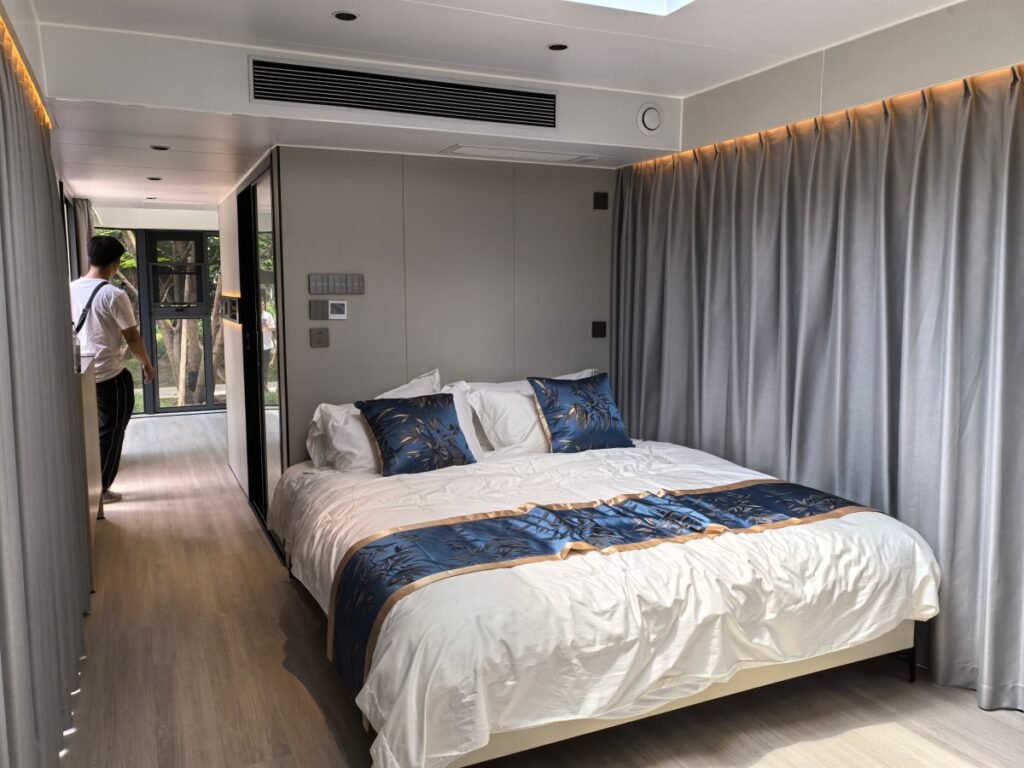
Know the site numbers first
Before you build, gather the basic wind data for your parcel. For this, you have to look up the basic wind speed for your area (given by your building code). Then figure out the risk category of the structure (usually a normal dwelling is Risk Category II). Next, you have to determine the exposure for your site.
If your capsule house is on open land by the sea, it will likely be Exposure D (flat, unobstructed terrain including water). The code may treat any site within a certain distance (e.g 600ft) from open water as Exposure D.
With wind speed, risk category and exposure, you need to calculate the uplift and overturning forces the wind will apply to your house and foundation. These numbers will tell you how strong your foundation and anchors must be. Actually, this means to size anchor bolts or piles to resist the calculated uplift and sliding loads. Plus check if your capsule kit can include extra tie-downs. For example: some manufacturers offer optional anchor kits or “anti-flood kits” with strong fasteners for high risk locations.
Thus, asking for these options early can make sure your foundation or pier will hold your capsule house down during a storm.
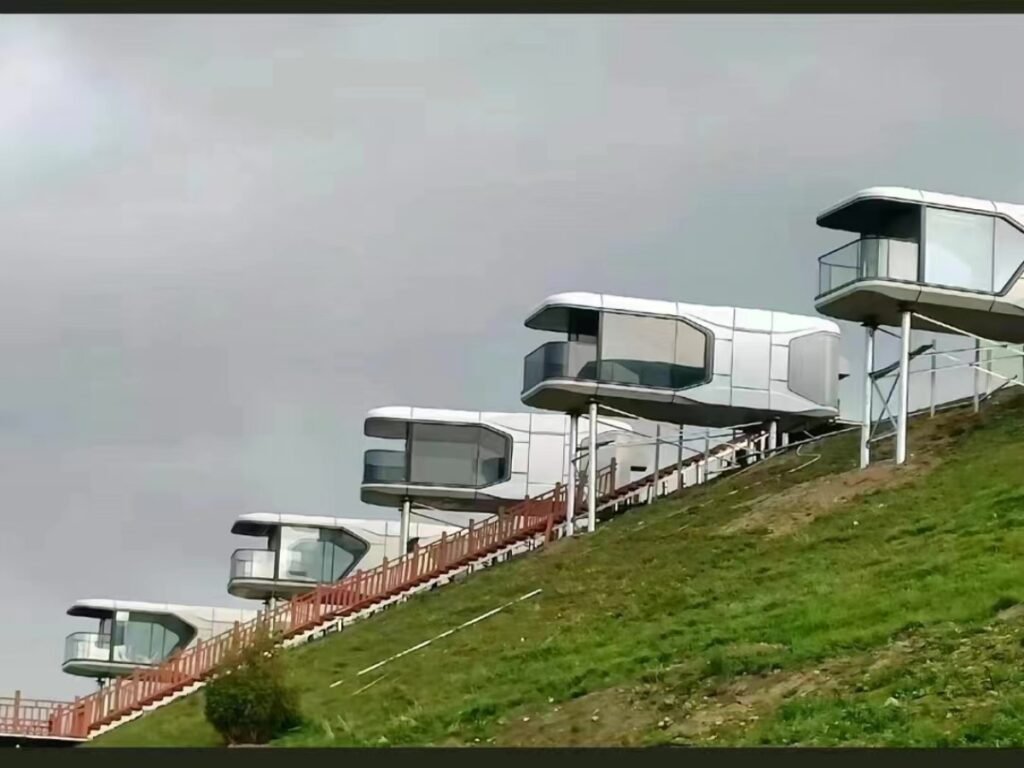
Structural strategy for capsule houses
Your capsule house design must be engineered and stamped by a professional. The design should have detailed the main steel frame or chassis, roof framing and how everything is anchored. For this, your engineer has to draw a load path diagram so you can see exactly how forces flow through the structure.
A basic load path might be: wind on the roof → roof deck → roof framing members → shear walls or diaphragms → main chassis frame → anchors or piers → soil. This shows you how every wind load is carried by one element to the next till the foundation.
Moreover, testing proves a continuous load path works. The fact is “IBHS tests showed that a continuous load path safely carries the wind forces through the strongest parts of the house into the ground”. Thus, you should size each part of the path accordingly (for example, calculate the required strength of wall straps, clips, anchor bolts, etc.). Plus, make sure your calculations cover the primary frame and all connections. Also, in a capsule house, the stamped drawings should show the steel framework and the anchor design. And you have to follow the engineer’s specs exactly when you assemble the frame and anchors.
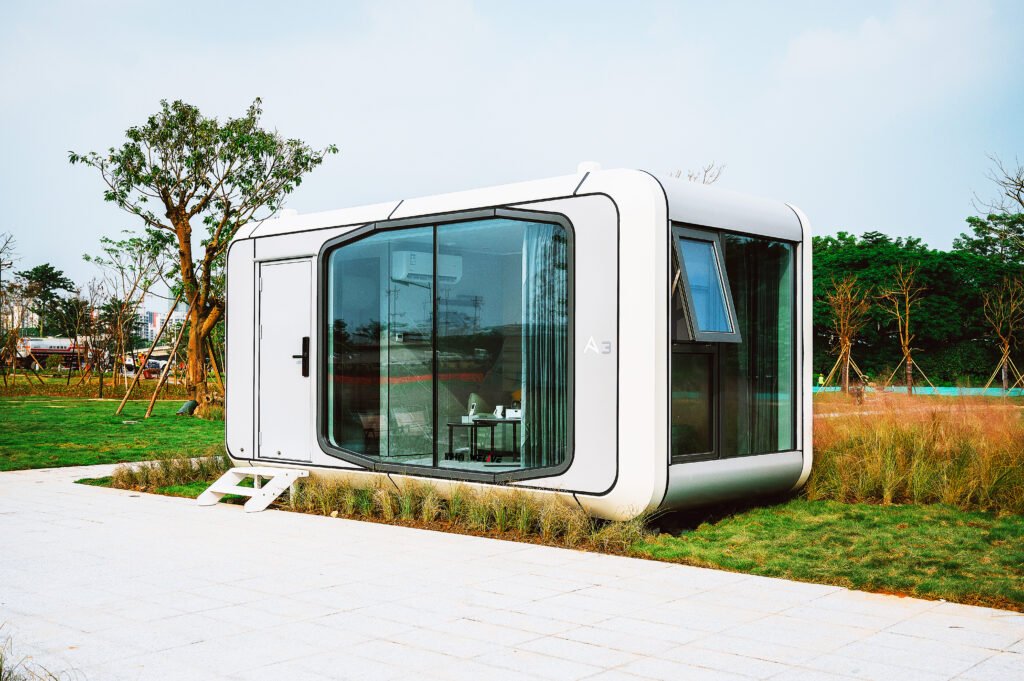
Roof edges and cladding where failures start
As we know, the roof is vulnerable specially at edges and corners. Wind mostly slips under loose edges and peels off the roof covering. To prevent this, you have to use a tested roof assembly. Like “IBHS Fortified standards require stronger roof edges”. They force you to use a wider drip edge and a fully adhered starter strip at the eaves. So, these create a sealed edge that resists wind uplift.
Also, you have to install your roof deck attachment with ring shank nails (or screws) in an enhanced pattern. Because switching to ring shank nails “nearly doubles the uplift resistance of a roof”.
The thing is, you have to make sure roof underlayment is sealed at all seams and turned up at walls. Also use high quality sealants on eaves, gable ends, ridges and around any roof penetrations (vents, chimneys) to keep both wind and water out. The goal is if wind hits an edge, it cannot force open gaps.
Thus, a well made capsule roof (mostly a curved one-piece shell) should be able to shed water easily and stay attached in hurricane winds if built with these methods.
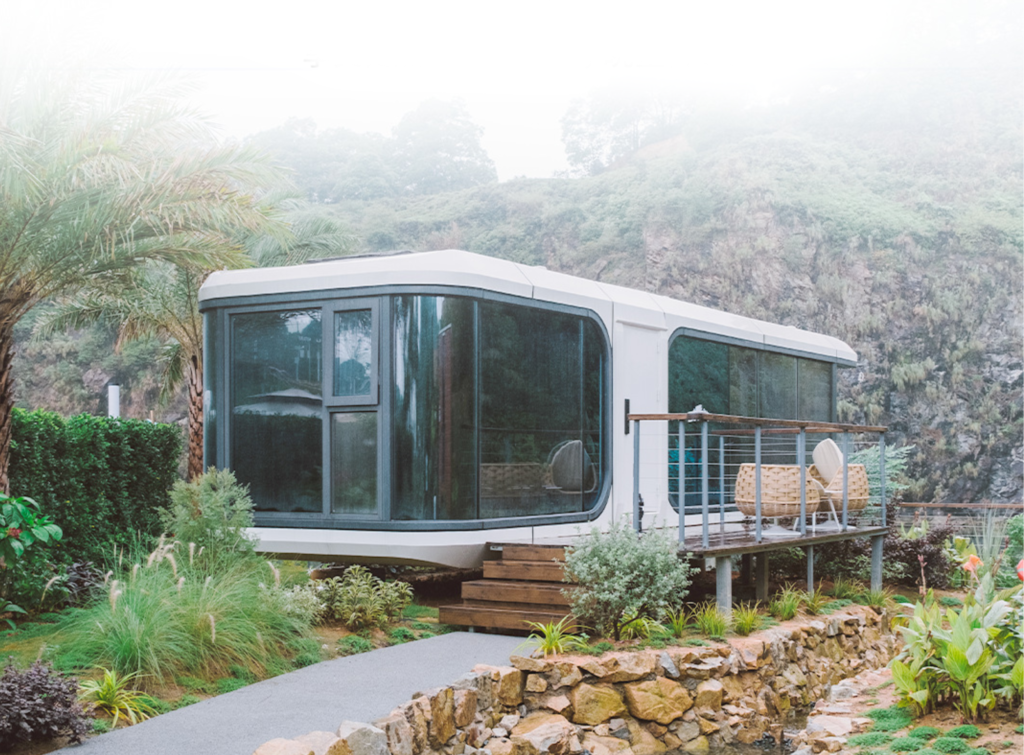
Openings that meet coastal pressures
The next more important thing is your doors and windows must be chosen and installed to meet the local wind pressures. As, in a coastal area you cannot use just any glass. You have to choose impact rated or high wind rated windows and doors.
Building codes more basically require all openings to be rated for the ASCE 7 design wind speed at your exposure. Like, “Fortified guidelines” say that in hurricane-prone regions, windows and exterior doors must be “pressure-rated to match the ASCE 7 wind parameters for exposure C or D”. This means buying windows that have been tested under standards like AAMA/WDMA/CSA 101, ASTM E330 or the Florida TAS standards.
Now, after choosing the right windows, you have to install them exactly by the installation manual. You must have to use all of the fasteners the manufacturer calls for, at the spacing in their manual. Sometimes they also need tightening each screw to a torque value. You know these details matter a lot: if screws are missed or overdriven, the window can fail.
Moreover, if possible, you should try to keep large glass panels away from the most exposed corners of the capsule. And be sure the perimeter sealant and flashing around every window or door are must rated for high winds. Thus, these steps make sure that the glass openings in your capsule will hold up to the coastal pressure schedule.
Foundations and anchoring that finish the job
A strong foundation for your capsule that resists uplift and sliding, must be on your priority list. For this, a level and rigid base is the best option to choose. Like reinforced concrete piers, pads or a slab. Each foundation element must have “engineered anchors” sized for the calculated loads. This means the anchor bolts or screw piles must be strong enough to counter the maximum uplift and overturning you will find. Plus, avoid using loose blocks or unanchored posts; as these can shift or let the frame rack under wind forces.
Moreover, you need to use corrosion resistant equipment (hot dip galvanized or stainless steel anchors, connectors) to stay longer. In the end, you have to confirm that the pier spacing, depth and anchor bolt layout match with your engineer’s plan.
Coastal extras that increase lifespan
We all know coastal salt spray can corrode metal quickly. That’s why you need to add extra rust protection. For this, you have to choose materials with a corrosion package. Like, you can use stainless or hot dip galvanized fasteners, zinc coated anchor bolts or weather resistant clips.
We use galvanized steel or aircraft grade aluminum for many capsule frames for longevity.
Also, try to use marine grade sealants (silicone or polyurethane) on all seams and edges.
If you are in an “official high wind zone” (like a Florida Coastal Area), then ask your supplier for product approvals or third party test reports. Also, windows and doors in some counties must have specific Florida Building Code approvals. Thus, having those documents ready will smooth the permitting process.
Flood-adjacent choices on coastal parcels
The last important thing is you have to take extra steps… if flood risk exists. For this, the first step is to elevate your capsule above the Base Flood Elevation (BFE). Actually this means raising the first floor on stilts or piles and giving your capsule freeboard (extra height). Like, codes often require building “2 feet above the BFE”.
Next, use an open foundation. Screw piles (steel auger anchors) or concrete piers are very popular. They can lift the capsule up (0.5-1 meter above ground) and leave open space underneath. Because an open foundation allows floodwater to pass under the capsule. This greatly reduces pressure on the structure.
Moreover, you must have to add diagonal bracing between piers for side-to-side strength. But make sure the bracing does not block water flow. Plus, you need to install flood vents or screened openings low on the foundation so water can flow in and out. Lastly, you have to seal all penetrations (electrical, plumbing) plus keep your utilities (panels, outlets) above the design flood level.
All these precautions give your capsule a “much better chance” to stay intact during a storm.
Conclusion
The sum up is: a capsule house can absolutely meet coastal wind and flood codes. But it requires careful design. You have to take care of little-to-little details… from the roof edges to the anchors in the ground.
As you plan your capsule house, work with an engineer and follow your local code guidelines step by step. And make sure you collect all the required reports and approvals for your capsule.
If you still need guidance or want to buy a capsule house built for your local zone, then contact our team.